Episode 57- We will all be Software Gardeners
Do you garden? I do, sometimes. I have a raspberry bed that I am proud of. Sometimes I grow a few tomatoes, lettuce, and the occasional pepper.
Prologue
Do you garden? I do, sometimes. I have a raspberry bed that I am proud of. Sometimes I grow a few tomatoes, lettuce, and the occasional pepper. My peppers are always weird, though. When I plant peppers here in the Pacific Northwest, they never really grow; they stay small, and sometimes only grow one baby pepper. I don’t know what’s up with that.
Last week, I outlined my 4 Levels of AI-Assisted Software Development. Level 3, the highest tier, (because it is zero-indexed), I described as:
At Level 3, you give the AI a plan and let it go off and execute it autonomously. You're not chatting with it in real time. You're not reviewing every change as it happens. Instead, you hand it a goal and come back later to see what it built.
I didn’t talk much about what that means, though. How do we scale that up, and what comes next?
TL;DR - In the future, we will all be Software Gardeners
Gardenologue
Last week, at the Esri Dev Summit, I built an app live in about 15 minutes. Most people would call this “Vibe Coding”—but I hate that term. It makes it sound like hoping for the best is the strategy for success. It makes it feel like there is no skill involved, but the opposite is true. There was a lot of skill in that presentation, but it isn’t something we are used to naming.
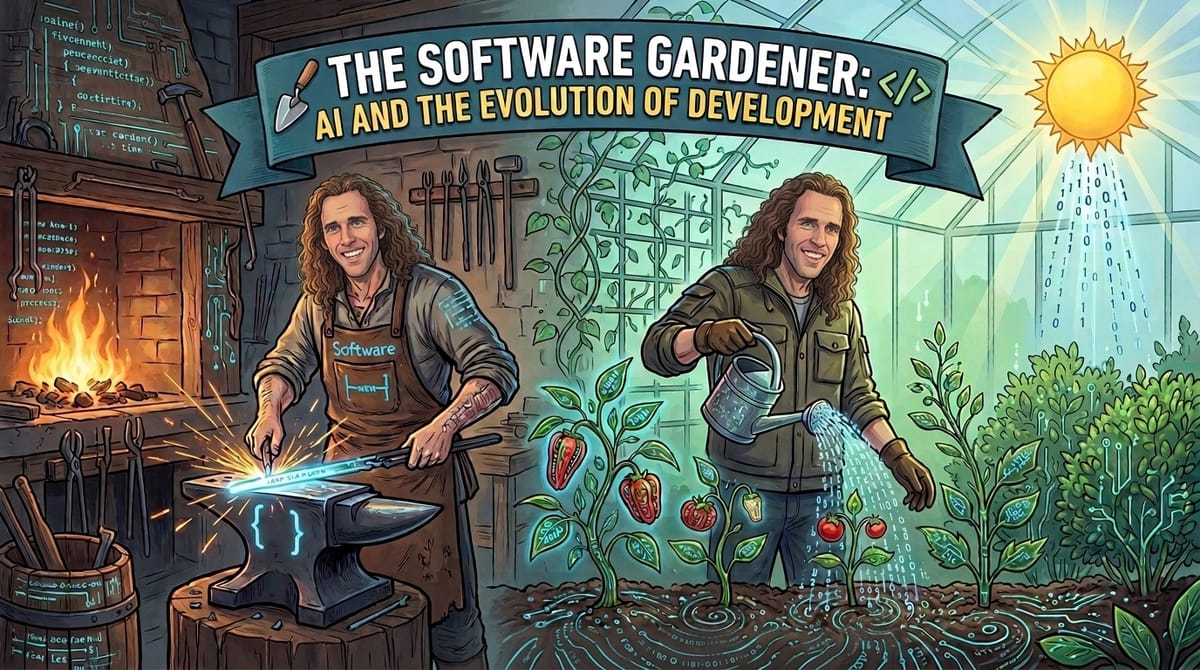
In truth, I think what I was doing is more like gardening than software development.
When I garden, I don’t build tomato plants. I can’t. I can’t construct a living thing line by line. Instead, I create the conditions for the plants to thrive. I choose the seeds, I prepare the soil. I water them. I make sure there is the right amount of sunlight. Then I wait, and I watch. I see what grows, and as it does, if it starts going in a direction I don’t want, I prune it. If something dies, I pull it out and plant something new. These plants are alive in ways that surprise me; they never grow exactly how I imagined. Sometimes it’s even better.
Why Not Factories
Factories produce identical widgets. That’s the whole point of a factory: you design something once and can stamp out copies. But software has never been like this. Each product is different. Every problem is slightly different, and even competing applications often solve the same problem in different ways. There is no identical, repeated stamping of widgets.
Software developers have always been artisans, like blacksmiths, carefully forging every line of code by hand. That era produced incredible things. But working with AI is a craft entirely different from that. You're planting, pruning, and guiding something that has its own momentum.
LLMs don’t work like factories either. If you ask them the same question twice, you will get two different answers. I don’t think that’s a defect to engineer away; it’s more like a living system, doing what living systems do.
A factory that produces unique output each time isn’t a factory. It is a garden.
As I was reflecting on that presentation at Dev Summit, it clicked: we’re already here. The future of software development isn’t some far away galaxy, it’s here now, people are already doing software gardening whether they call it that or not, strange peppers and all.
My goal is autonomous software delivery, and I think gardening is how I’ll get there.
Newsologue
- Nvidia announced a lot of things this week. One fascinating one is NemoClaw, an “enterprise and security focused tool” for OpenClaw. This is really important as tools like OpenClaw are very powerful, but also very dangerous. And our security systems are not yet ready. For example, I want to allow my agent Read and Draft permissions to my email, and not Delete. I can’t do that today.
- One more from Nvidia—they created a way to use JPEG style compression to hold the key/value store used in AI chat applications. Reducing this memory footprint means more AI answers faster, since it turns out memory, not compute, is the biggest bottle neck for an AI answering questions with large context. This isn’t the first time we’ve seen compression from images in research. The proof will be in the production pudding.
- Anthropic’s Claude Opus 4.6 gets a 1-million token context window by default. I think this is the first time that Anthropic has made that the default, and not a beta feature. I can’t say I have noticed a difference in Claude Code, except perhaps that it takes a bit longer before I have to compress.
Epilogue
This idea came from my coworker Richard Zwaap, and I’m in love with the metaphor. He was doing a lot of reading and thinking about Software Factories and came away convinced the analogy was flawed. Primarily, I think, because factories produce widgets that are all exactly the same, and that isn’t how Large Language Models work. Rich’s concept is “Software Farming,” which I love, but I also think that Gardening is a bit easier to wrap our brains around in the near term. From those thoughts, I wrote this post, Jaws edited, then Holly edited.
This episode was harder to write than most of my previous ones. This one is more like theory not a technical discussion, which was a new branch for me. I think this metaphor has more to give, so I won’t prune this one; instead, I’m going to water it more. More on that soon.