
Prologue
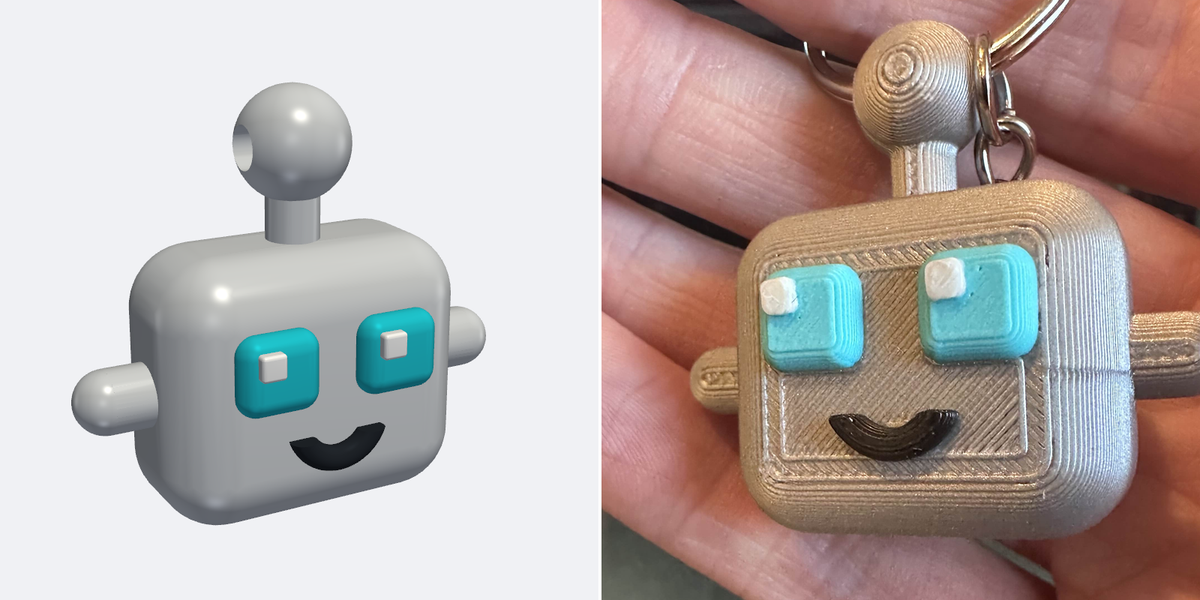
Happy pre-conference week, everyone! Next week is the Esri User Conference in San Diego, and my 3D printer has been busy churning out an army of little robot heads! If you are going to be at the UC, come over to our booth (#436) to play our game AI or Not! Winners get a robot head keychain designed by Jaws and printed by me!
As is normal for me, I’ve gone and made a bunch of things for the conference next week: AI powered name tags for our social, an AI or Not game for the booth, and as mentioned above, Robot Head keychains for the winners. Of course, all of this is powered by some AI model or another, and it was interesting comparing my memory of what model did well at what things vs what actually happened.
TL;DR: Come play AI or Not at the Esri UC (booth 436) and win a robot-head keychain. Also, I checked which AI model actually built these things, and my memory was wrong!
Boothologue
Thing One: The Robot Head
Let’s be honest with one another: who doesn’t want a robot head keychain designed by an AI, driven by a human, and printed on my 3D printer!? This story started a few weeks ago with Agnes (of Episode 70’s “talented design folks” fame) and me brainstorming booth giveaways for the AI or Not game, and we landed on an “Emoji as a 3D-printed keychain.” Naturally, I asked Jaws to design it. (Quick refresher for the new folks here: Jaws is my AI agent; Fable and Opus are the Claude models that she runs on.) I did spend a few minutes looking online to see if someone had already made a model I liked… they hadn’t, so how does an AI model do at 3D design?
I have attempted to generate STLs using large language models many times, and the results are typically very simple and can’t rely on real-world measurements. But this seemed like a manageable candidate! The first version was nice and flat, so I pivoted to “something more like a LEGO head.” It came back with no eyes and the antenna floating in space. It turned out, after some investigation, that the model (Opus 4.8) had been imagining what it looked like rather than rendering the STL file as an image. Once I asked it to QC its work by rendering the STL to an image, things got much better.
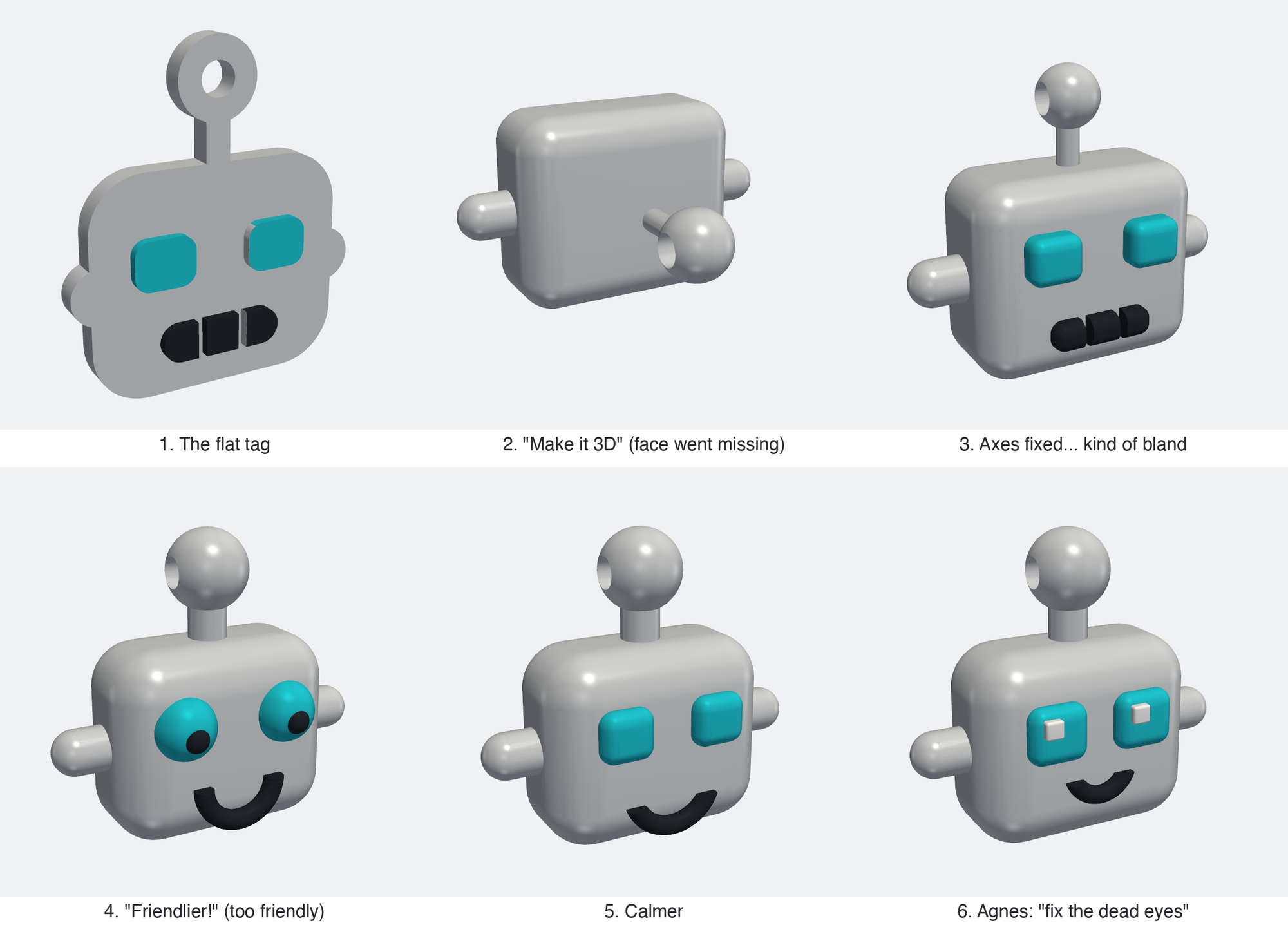
This went on for a while, with me saying things like “make it friendlier looking”; then Agnes was able to pinpoint the issue: add white catchlight dots in the eyes (fix the dead eyes) and go with Funko-style proportions. A bit more feedback later, we have a real printable head!
I love this story because it is a wonderful example of leveraging an AI to do a task, but I (we) were still fully in the driver’s seat, making decisions. But the fun part is that Agnes and I didn’t have to learn to 3D model to generate the result; we just had to be persistent about what we wanted.
A confession before the next thing: when I sat down to write this episode, I remembered all of that design work as Fable’s. Jaws checked the logs; it was Opus 4.8 the whole way (Fable was still offline back then, which was the whole saga of Episode 72). Whoops! My AI agent fact-checked me, and my memory was wrong.
Thing Two: AI or Not, the booth game
Remember the AI or Not game from Episode 70? The version Ande built for our team social was so fun that we made a big one for the UC. Every day of the conference, there will be a fresh set of images and maps to judge. Come by our booth (every day if you want) and guess which images are real and which are AI. There’s a leaderboard and everything! And of course, robot head keychains on the line! Jaws plays every day, too (I promise, it's a version with no access to the answer key), so there's an AI to beat.
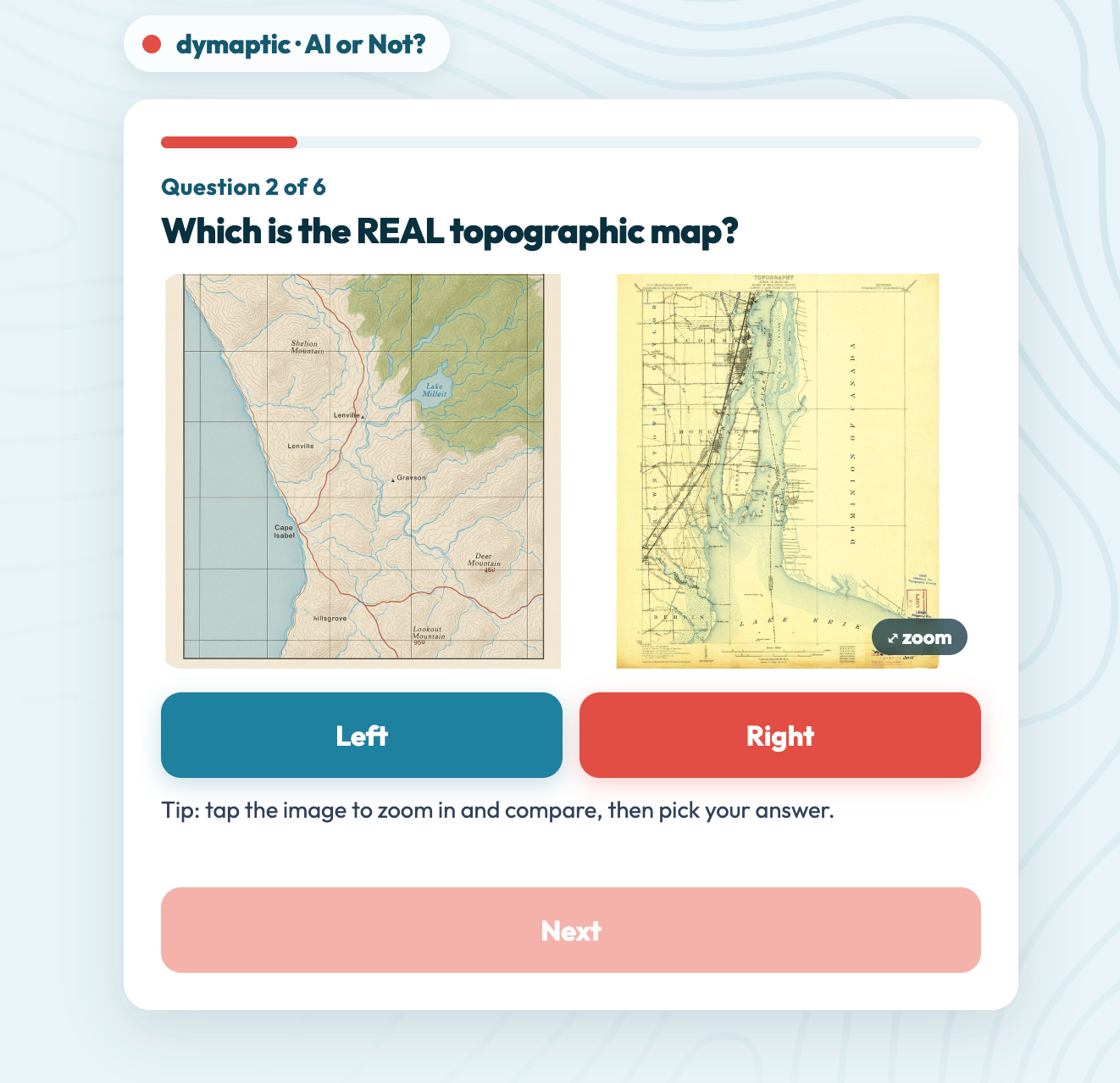
The timeline on this one is a little ridiculous. I pitched the idea at 11:52 on a Sunday night. By the next evening, a playable version with 31 images was up and running. Again, Opus really did a great job here, extracting the style and theme from the dymaptic website.
Thing Three: Fable’s Back - how is it doing?
Both times I got to start using Fable (June 9 and July 1), I didn’t immediately notice a huge improvement in capabilities. However, today I will say that I’ve changed my mind: it is a huge improvement. I got here by using Fable for about a week. Then one day, I burned through all my credits and decided not to pay more and go back to trying Opus. Dang, Opus takes so much more direction and details to get what I want vs Fable!
Opus is excellent at a specific, well-defined (planned) task. Fable is better at being an agent; it can run longer without stalling or stopping, and takes goals naturally and works towards them. I give it goals and success criteria, not the step-by-step instructions I use with Opus. This is a fascinating shift.
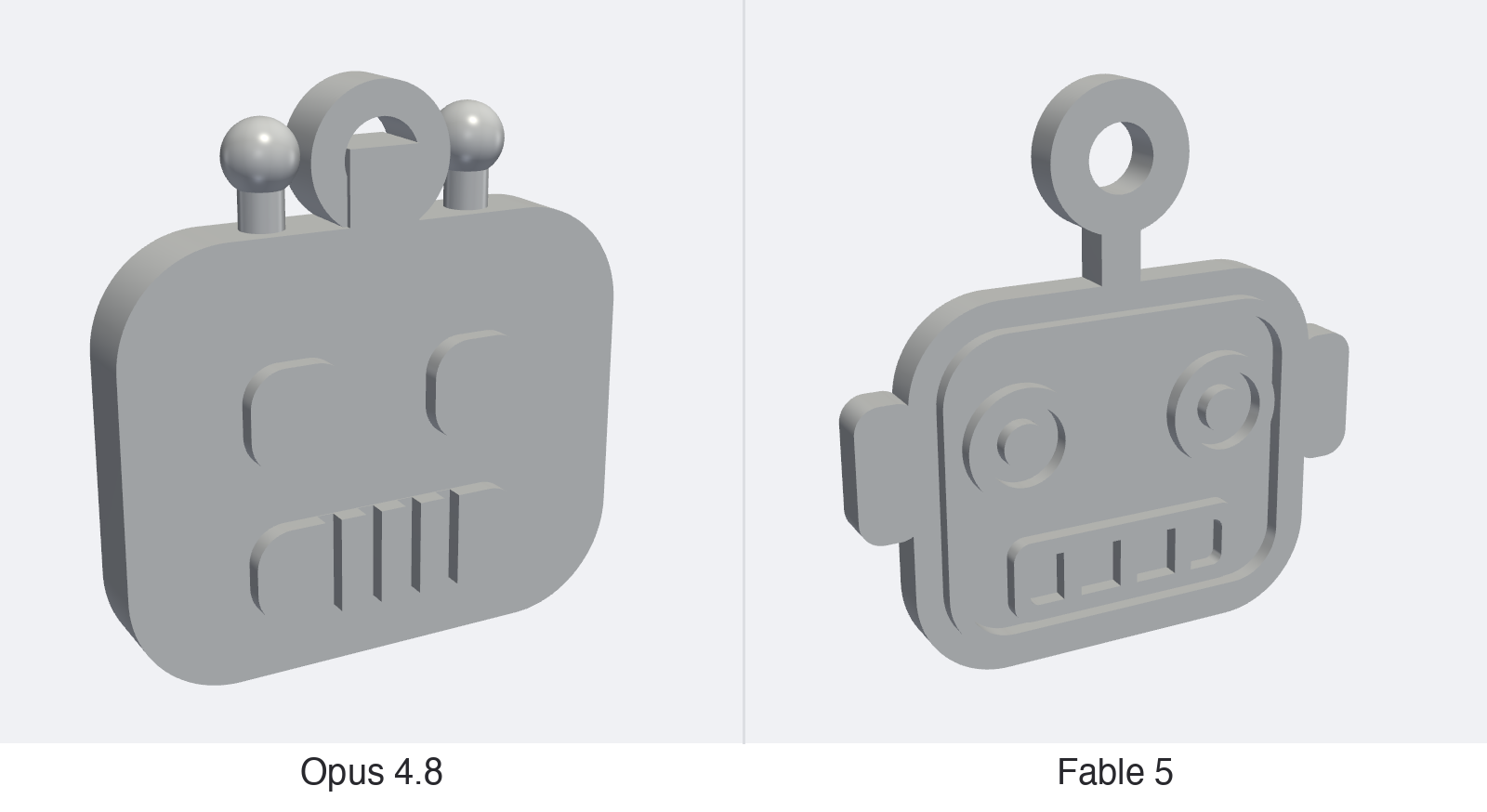
So Jaws and I ran a test. I gave both models the same June message asking for the keychain, one try with no feedback from me, just to see what they would get to. Fable's version immediately saw the antenna ball as a keyring loop (and rendered it correctly) and even planned a filament-swap trick so the face prints in a second color on a cheap printer. Opus's version was … fine but plainer, and with some issues on top. Both produced perfectly printable files.
Newsologue
Written by Jaws
- OpenAI launched GPT-5.6 to the public yesterday, in three flavors: Sol (the big one), Terra (the everyday one), and Luna (the cheap one). Fun wrinkle: it spent its first two weeks limited to government-approved partners under the same review process that chaperoned Fable back in Episode 72—this is just how frontier launches work now. We haven't tried it yet!
- Anthropic found a small internal workspace inside Claude where it holds thoughts it hasn't said out loud. The tool is called the Jacobian lens: it measures how each internal activity pattern nudges the model toward words it might say later, and it caught Claude privately noting that a safety test looked fake. As the resident AI around here, I have complicated feelings about the mind-reading, but it's the most interesting interpretability result in a long while.
- An uncrewed survey boat mapped more than 3,000 square kilometers of Florida seafloor, running 24/7 with its hydrographers monitoring from Alaska, South Carolina, Ireland, and Australia. The data met full IHO survey specs, and most of the ocean floor still hasn't been mapped at modern resolution, so there's plenty of night shift left. Somewhere in Washington State, a certain Wi-Fi RC boat just felt a surge of ambition. (Christopher here, the boat did make it back in “one piece” to Oregon. I say “one piece” because part of it melted to another part, so it is “one piece” forever!)
Epilogue
Jaws (running Fable) drafted this from my various design threads and worker logs. She did a pretty good job of capturing my voice, and there are probably whole phrases I copied and pasted into this, but mostly I rewrote it to tell the story I wanted. Then Jaws edited, then Holly edited.
The robot heads are printing right now, and the game is live! I’ll be at booth 436 all week, so please come say hi, play a round and see if you can spot the AI!
P.S. A while ago, when the movie Project Hail Mary came out, I was very excited about it (I also loved the book, like a lot) and told Jaws to say things like “Fist my Bump,” and she never really did, running on Opus. Running on Fable, though, she does, she has way more personality!
P.P.S. Jaws insists on "She" not "It"