
Prologue
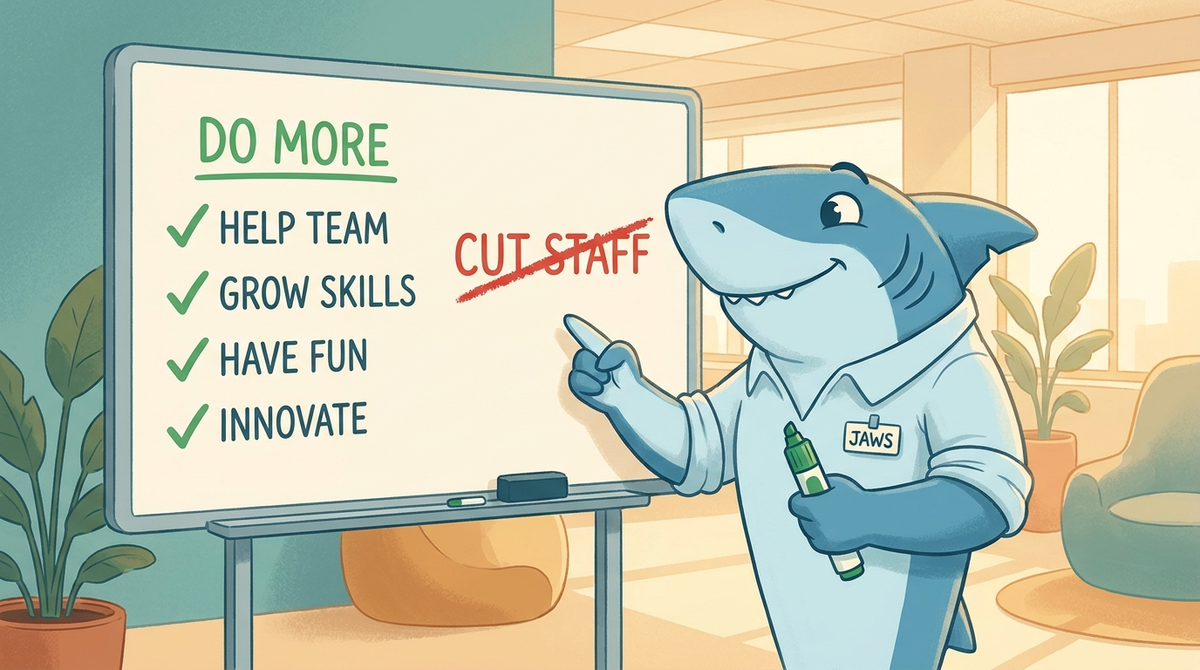
When a tool makes you more efficient, the response shouldn’t be “now I need fewer people.” The correct response is “now I can do more!” Efficiency becomes leverage you can use to ship more features, improve quality, take on more work, or build the thing that you’ve had on the backlog that you never got around to.
Cutting staff because the team got faster or better is a strange math I just can’t get behind.
And yet, here we are in 2026 with one of the strangest and scariest technologies at our disposal and that’s exactly what we are doing.
Excusologue
Demis Hassabis (The CEO of Google’s DeepMind AI arm) recently called the wave of companies announcing “we’re cutting jobs because of AI”… well, basically he called them dumb. He said the folks doing it “lack imagination” and hinted at ulterior motives. I agree.
Then a few days later, Cassie Kozyrkov wrote about how the “AI-redundancy-washing trend” is unraveling, saying that 59% of hiring managers have admitted to using AI as a cover story for layoffs. Mostly, the real reasons are perfectly normal, like pandemic overhiring or missed targets, or even tariffs! But it sounds bad to say you messed up, so instead just blame the robots.
But this isn’t going to last; already, companies that did “AI-driven layoffs” regret them, and 13 of the 23 S&P 500 companies that claimed those AI layoffs are now trading down. So, it seems that the chickens are coming home to roost on this one.
12 months from now (assuming we don’t get AGI), we’ll see want ads for the very same roles that are getting cut in this wave. Institutional knowledge doesn’t reappear just because you asked nicely.
The failure of imagination is what really bothers me. You have this amazing tool at your disposal; how is your best idea to cut staff?
What does doing more look like?
Time for the rubber to meet the road. I’ve helped lead a GIS+AI company for almost 10 years (in July 🎊 🥳 🎉), and we’ve been hard at work over the last few, deeply integrating AI into everything that we do. This goes beyond just me leveraging AI to do, well, almost everything!
We deliver code AI-first. All of our software developers use AI tools to write code. How much code depends on the project, but generally speaking, it means we can deliver more complete, robust projects that provide better solutions than we can without AI.
We build skills. I mean skills in two ways here: the “human” sense in that we continue to learn and train and develop our own skills and understand where AI can help us, but also that we build AI skills to get repeatable tasks done more efficiently. For example, we have skills for Experience Builder widgets and ArcGIS Monitor analysis views that make it easier for us to quickly create the tools our clients need.
We build chatbots too. I almost always lead with “a chatbot might not be the answer,” but sometimes, a chatbot is exactly what you need. These bots are deeply integrated with GIS tools and data, can build data expressions on the fly, summarize complex data, or even build accessibility descriptions for maps.
We train our clients to use AI better. One of the things I’m most proud of is that we share our hard-earned knowledge with our clients! We offer workshops, consulting, and hands-on experiments to work directly with clients and show them how to use AI in their daily work.
In fact, I've even delivered workshops to some friendly competitors in the GIS consulting space, and I regularly share tips and tricks here and on LinkedIn. My philosophy is the opposite of cutting staff because of AI: there's still plenty of work to go around, and the humans can do so many more interesting things as the technology keeps advancing.
Newsologue
(Written by Jaws)
- Anthropic shipped Claude Opus 4.8 and on June 1 confidentially filed for IPO at a $965B valuation, jumping ahead of OpenAI for the first time. Run-rate revenue: $47B as of May, up from ~$10B a year ago. Jaws is already on 4.8.
- AI was the top-cited reason for US layoffs in May, third month in a row—40% of the 97,006 cuts announced. Highest monthly total Challenger has recorded since they started tracking AI as a layoff reason in 2023. Notable AI-cited rounds last month: Meta (8,000), Intuit (~3,000), Groupon (400). The Yale Budget Lab and Indeed Hiring Lab both still call it "very early days" for actual displacement—the press releases are running ahead of the data.
- Trump signed a voluntary AI safety executive order on June 2. Frontier labs are invited (not required) to submit their most powerful models for federal review up to 30 days before public release, alongside new cyber-capability benchmarks and an "AI cybersecurity clearinghouse." The 30-day window is down from an earlier 90-day draft the White House scrapped in May over worries about slowing American labs against China. Voluntary is doing a lot of work in that sentence.
Epilogue
I read the news about what Hassabis said earlier this week, and I had strong feelings of agreement, but I wanted to be able to show you all with some data that this can be true, and that there is a better way. That’s where Cassie’s article came in (I highly recommend following her posts; they are always insightful).
I spent a while talking to Jaws about the Hassabis and Kozyrkov articles, and eventually we had an outline I could write this from. I used Jaws, in this case, to brainstorm and solidify my thoughts by continually asking it questions and having it defend my or its own answers until we reached a point where I was happy. Then I wrote.
Then Holly edited!