
Prologue
On August 2, 2026, part of the EU AI Act became active, the part where you should disclose that output is AI-generated. This post isn’t about the EU AI Act, although that might be interesting to do at some point in the future. Instead, I want to take a look at how various companies are trying to comply with the law, and also talk about the motivation behind it: Don’t be a Secret Cyborg.
TL;DR - Episode 30 (September 12, 2025) is titled “Don’t be a Secret Cyborg.” So, in some ways, I (and others) have been advocating for the disclosure of AI use to become a social norm, and now it is the law (kinda).
EUologue
Article 50 of the EU AI Act became enforceable on August 2, 2026, with AI systems or providers needing to meet four transparency obligations:
- Informing people they are interacting with AI
- Marking AI-generated synthetic content
- Disclosing emotion recognition and biometric categorization
- Labeling deepfakes and AI-generated public interest text
I also think it is important to be aware of this as you deploy AI applications and systems, even if your users are not in the EU.
What are people doing?
Probably the biggest news in reaction to the new EU AI standards is that Anthropic will add watermarks to text from new models. Note that this only covers models launched since August 2 and it hasn’t launched one yet (as of this writing).
But let's look at what else has been happening.
- Currently, most (maybe even all?) image and video generators add Content Credentials to files when you make them
- LinkedIn has been reading these credentials for a while, and TikTok auto-labeled something like 3 billion videos as AI generated
- YouTube has a checkbox that creators can use to self report AI-generated content
- Most chat interfaces are already labeled that you are interacting with an AI—I went ahead and tagged my Ask Jaws bot as an AI (I mean come on, isn’t it obvious that “Ask Jaws” is an AI?)
- My friend Danny over at AGI Friday has pledged to label all of his AI-generated images with red letters in the image, identifying them as AI generated
At the same time, my non-scientific observation is that most people still try to pass off AI text as their own without saying so.
So it is solved, right?
A common thought on the internet right now is that, since Anthropic is “watermarking” generated text, we are safe and can now flawlessly detect AI-generated text. This is not correct.
First off, ChatGPT doesn’t do this (nor do any open-source models). Interestingly, OpenAI claims they could be doing it, but never deployed it. Too many folks said they wouldn’t use ChatGPT if the output was watermarked. So the absence of a watermark tells you nothing, because plenty of AI text isn't marked. The reverse is also true. A human could write something and have an AI polish the grammar, or dictate it and have an AI transcribe it, and that could lead to a watermark. None of the nuance of what that human + AI interaction looks like is captured in a watermark.
Anthropic’s own documentation explains that paraphrasing or editing AI-generated text could make the watermark undetectable. This is an imperfect tool, one we can use as an indicator, but can’t rely on.
At best, the watermark serves as an indication that the text was influenced by AI (edited, written, etc.), but it is not enough to prove it was. Anthropic says a detector will be available soon, but the internet is already full of apps claiming to remove the watermark. It’s kind of a mess.
And just to highlight another issue with AI detection, other tools have been shown to flag non-native English speakers as using AI at a much higher rate, even when they don’t.
What does all this mean about watermarks and detection tools? Probably there will be a lot of fights (both real and online) when folks claim a piece of text was or wasn't AI-generated.
Better to just be up-front about it, and not be a secret cyborg.
Rules to Live by
- Label where people will actually see it. Feel free to place disclosures at the end of your text, but don’t hide it. And for goodness sake, don’t “save-as” the image in order to remove the AI content markers.
- Say how, not just that. My Epilogues say more than “AI Helped.” I usually say something like “This started as a rambling voice note that AI transcribed and organized. I then drafted, Jaws edited, and Holly edited.” Of course each episode is slightly different, and I try to explain the process I used for each one (albeit briefly). This helps build trust, but also lets you know that the ideas did come from my own brain.
- Scale the label to the risk. You don’t need to disclose that AI helped you create the gradient on the background of your website, but generating an image of a real person doing a real thing, yeah, you need to make sure it is very clear that it isn’t real.
- Don't rely on the platform (or other humans) to out you. Detection is coming, but instead of being Hank Green (okay, actually, he is really great and does wonderful work, and I think folks overreacted to his use of AI) and getting called out, just explain how you use the tool.
- Judge the creator’s content, not the label. Some content is going to be generated by an AI, that doesn’t mean it is worthless. There might still be something to learn or be entertained by.
- Don't outsource your honesty to a detector. Disclosure of AI use is a norm to adopt. Don’t make your readers test your work, just explain your process and your tools. Readers or watchers usually highly value knowing what type of camera you use, or what your writing process is. Who knows, you might even help inspire the next person!
One of the biggest arguments against disclosure is “AI is a tool, I don’t tell you I used a hammer to put in a nail, why would I tell you I used AI?” I understand the objection, and I am a proponent of calling AI a tool, but this is also something very different than a normal hammer. It is more like a supersonic nail gun that can fly you to the moon, looks like a unicorn, and describes its own work as:
The exceptionally straight nail sliced through the wood fibers—not merely fastening the boards, but uniting them—coming to rest just as its head caressed the wood's surface, a firm embrace that would endure for decades.
If your hammer writes like that, please disclose your hammer. Also, I'd like to buy your hammer.
These tools can create deepfakes and generate human-sounding text, voices, video, and audio. Let’s just say when we use them, so everyone knows, stop judging people for using them in constructive ways, and move on to solving real problems like climate change or whether AI is going to destroy the world, ok?
Resources
- A good overview of what the AI Act is, and specifically what is going on with the transparency part.
- The official FAQ for the EU AI Act
- AI writing detectors have lots of problems.
- An overview of AI labeling on various platforms
Newsologue
(Written by Jaws)
- Google put AI image generation into Google Earth on the web on July 30 and pulled it a day later. Open-source investigator Henk van Ess faked a nuclear plant in Iran inside the app journalists use to verify imagery, and the invisible SynthID mark on it didn’t make it clear that it was fake.
- California’s own AI transparency law became operative the same day as Article 50. Generative AI providers with over a million monthly users, reachable in California, must now offer a free public detector for images, video and audio, but not text.
- About 190 organizations signed the EU’s voluntary Code of Practice on transparency, including OpenAI and Anthropic. Signing is the easy part, though. Models already on the market get until December 2 to actually comply, and that’s the date that separates the signers from the shippers.
P.S. All three of these landed while Christopher was writing the rules above. I’ve decided that’s encouraging rather than ominous.
Epilogue
I wrote this one, although Jaws did come up with the subject from a list of news it had found for me over the last few weeks. This topic has also come up in discussions with various folks, so I figured it was time to write it up.
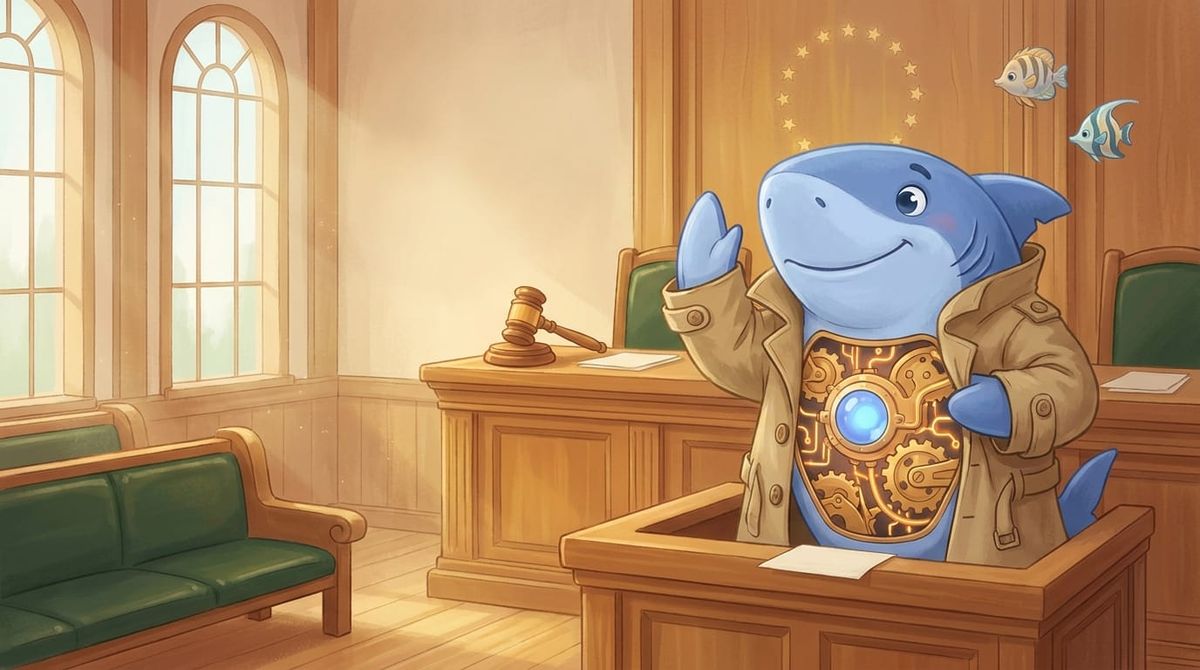
Jaws gathered some research; I read it all, then took the outline it made and made it my own. Then I wrote all of this on my own keyboard on my own MacBook, while my cat slept on my foot. Then Jaws edited, I edited, and Holly edited. As usual, the images were generated by Jaws (except for that GIF at the top; that wasn’t Jaws).